
I’ve spent the last week working with Opus 5.5 and I’m loving it (except for those annoying safety filters that trigger whenever you mention something security-related, no matter what). It’s significantly better than Opus 5, and cheaper ($20 per million output tokens compared to the $25 of Opus 5). And this wasn’t the only recent release that landed with more intelligence at a lower price.
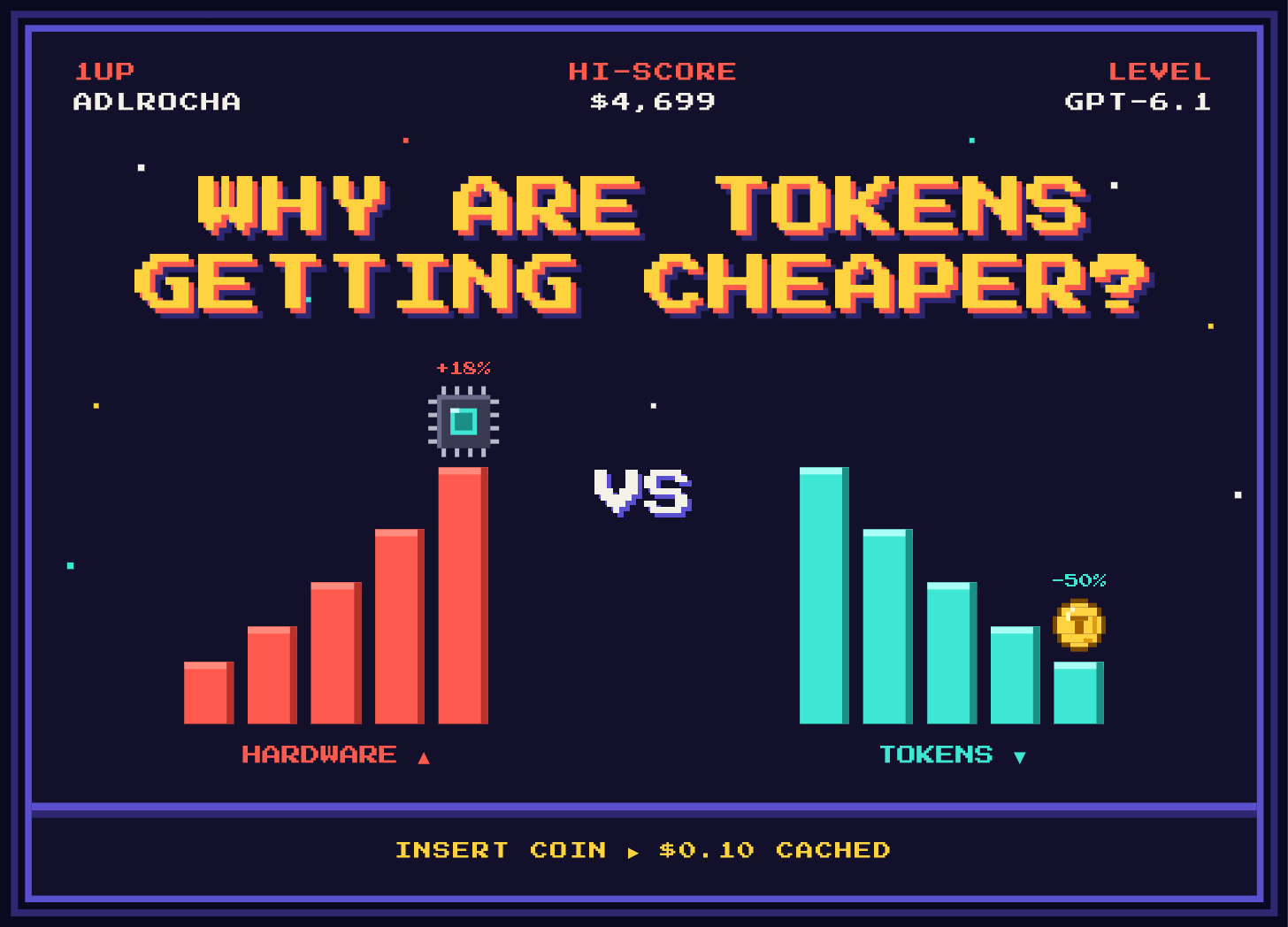
In the space of eight days, xAI shipped Grok 4.7 at $6 per million output tokens, OpenAI released GPT-6 and halved its prices, and Anthropic launched Opus 5.5 at $20 per million output instead of $25 and raised the usage limits on its subscription. Then Anthropic released Sonnet 5.5, which scores within two points of Opus on its knowledge-work benchmark for half the price. And to add to all of that, this week OpenAI followed up with GPT-6.1 Sol, which completely obliterates prices at $2 ($0.10 cached) per million input tokens. All of them are smarter (according to benchmarks) than the model they replace, and all of them cheaper.
What the hell is happening here?
Hardware keeps getting more expensive and most of these labs are still losing money, so did they really get that much better at building and serving models in a few months, or is the market pushing the floor downwards?
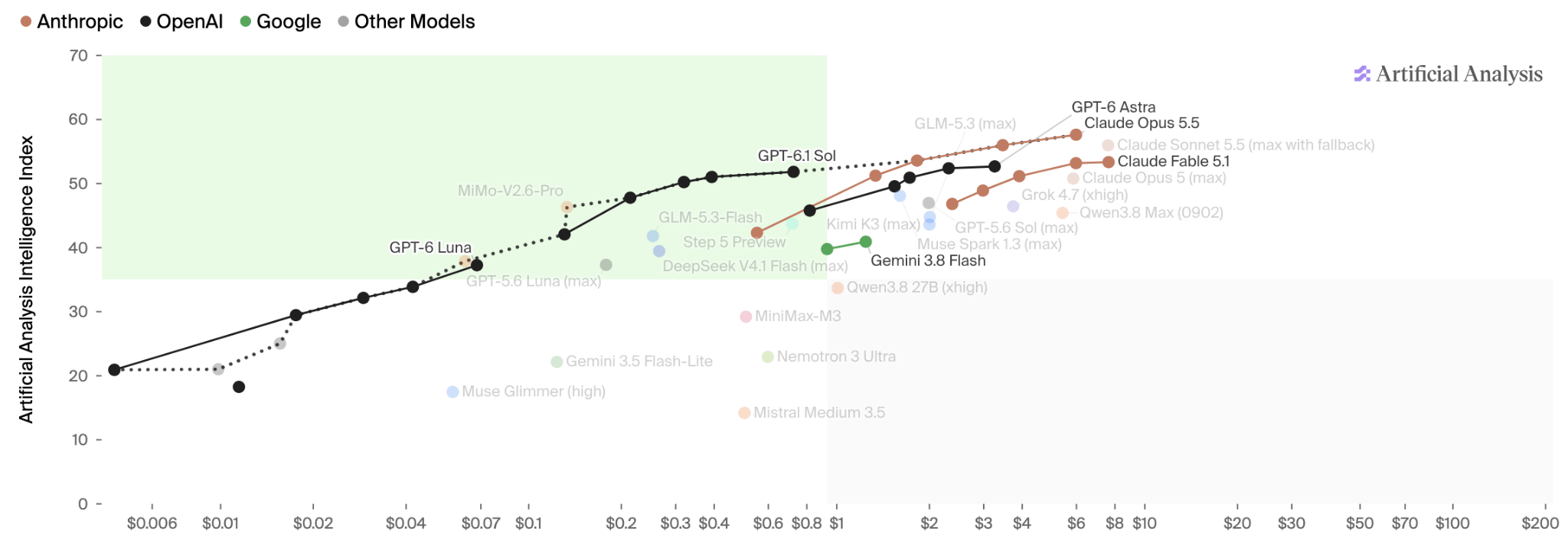
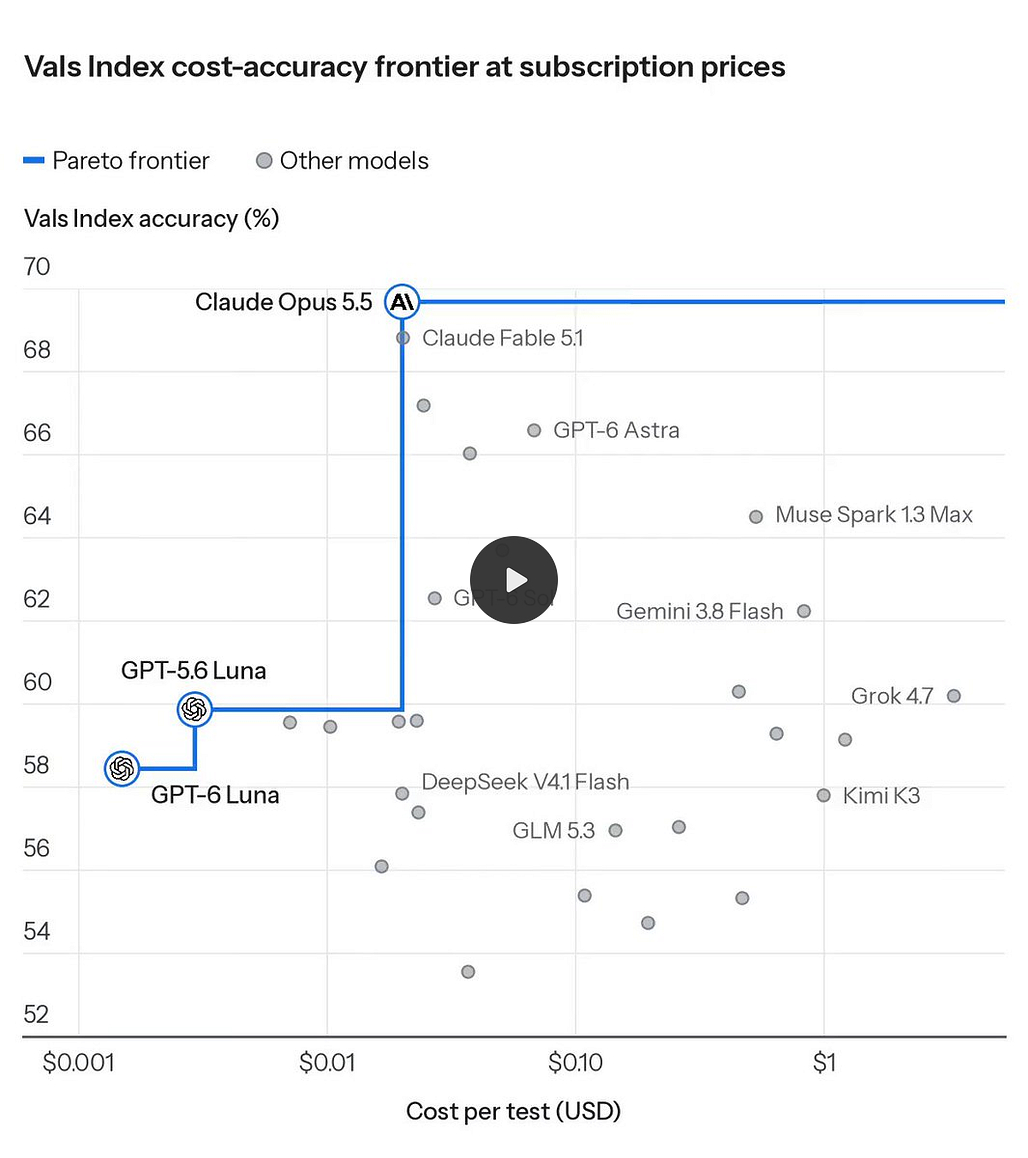
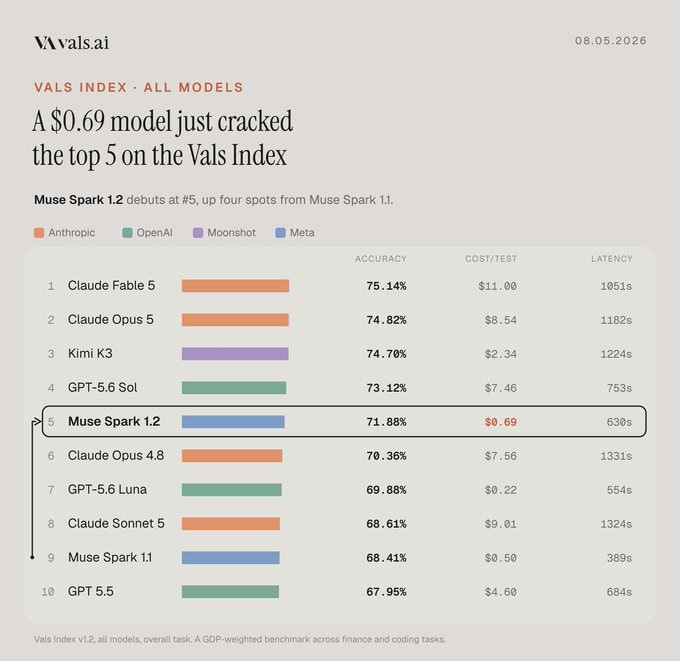
There is something quite revealing in all of these announcements, every one of these launches came with the same chart, the Pareto frontier. Meta celebrated Muse Spark landing on it, Artificial Analysis said GPT-6 “pushes the cost efficiency frontier”, and TypeSafe introduced a decision model called Jev that is, in their words, “owning the Pareto frontier for almost 2 orders of magnitude” (we will talk about decision models and how they differ to LLMs next week).
My bet is that this is a mix of model improvements and market forces. Better architectures make the price cuts possible, and a market with no moat (at least yet) and almost no switching cost makes them necessary. We already know what happened in the dial-up price war of the 1990s, this only ends well for whoever owns the network (and all the users).

What is the Pareto frontier?
Picture a chart with intelligence going up and the cost of finishing one task going across, like the one from Artificial Analysis that you see above. Every model is a dot. A model sits on the frontier if no other model is both smarter and cheaper, and if you join those dots you get a line that bends upwards. Everything below the line is “dominated”: some other model beats it on both counts, so on these two measures there is never a reason to use it. The name comes from Vilfredo Pareto, an Italian economist who used the idea for trade-offs where you can’t improve one thing without giving up another (you’ve probably heard about the guy already for his 80/20 rule that we like to apply everywhere).
The dots are really curves. Most models now let you choose how long they think before answering, from low to max effort, and each setting is its own point. That’s how OpenAI’s small GPT-6 Luna, thinking at max effort, beats the previous Sol on medium for about a tenth of the cost (and this is why you always see a “High” or “Max” along with the model name in all of these benchmarks).
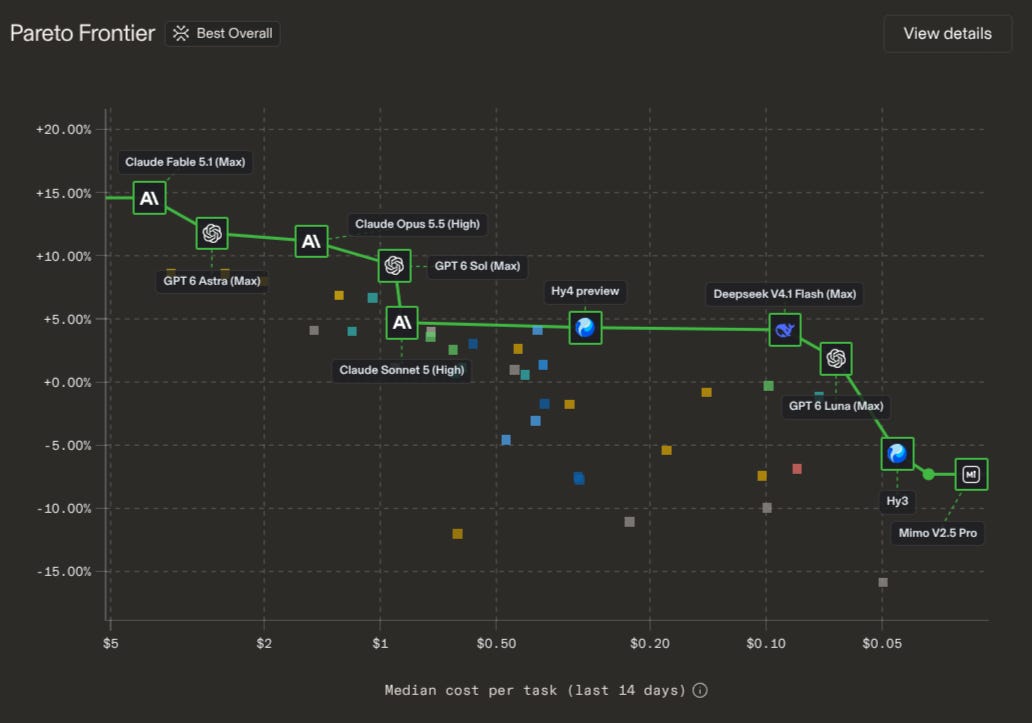
The horizontal axis is cost per task, not price per token, and this is a key distinction that many people don’t realise. I keep hearing in conversations the usual “but Qwen3.8-Max is cheaper per million tokens”. Sure, but Qwen is an over-thinker (which I am not saying is bad, I love Qwen models, but when you pay per token for a specific task, it may not be the best contender).
We have a similar example in the OpenAI family, Luna uses far more tokens per task than Sol because it thinks longer, which eats into its lower price. Sonnet 5.5 kept exactly the per-token price of Sonnet 5 but costs up to 30% less per task because it gets to the answer in fewer tokens (a clever way of cutting the price without touching the price list.)
The practical rule is simple: decide how smart the answer needs to be, and pick the cheapest point on the frontier that clears that bar. Anything above it is money spent on intelligence your task can’t use. But be careful, because whoever draws the chart picks the axes. Jev “owns” the frontier on TypeSafe’s own workflow tests, and it’s a narrow model built for fast, structured decisions rather than a general assistant (I’ll write about it properly soon).
Is it the technology?
As you may all be aware by now, hardware is getting way more expensive (I regret not buying those DGX Sparks and GPUs when I could). I already wrote about this in the first quarter of the year. Memory makers have moved their capacity to the high-bandwidth chips that go into data-centre GPUs, and memory contract prices rose another 15% to 20% this summer. NVIDIA raised the DGX Spark from $3,999 to $4,699, blaming memory (and this is if you manage to find it in stock). So whatever is making tokens cheaper, it is definitely not cheaper silicon. My hypothesis is that labs are managing to squeeze more out of every chip that they have available.
We’ve been seeing a glimpse of it in the open models that I’ve been writing about the past few weeks. Kimi K3 made it cheaper for a model to look back over a long conversation. GLM-5.3 and Qwen3.8 got their gains from better post-training on the same architecture. The Flash models shrank near-frontier intelligence onto hardware one person can own, and DeepSeek V4.1-Flash keeps a third of itself out of the GPU altogether. Every lab is pulling a different trick, but all of them are after the same thing, more intelligence per unit of compute.
And while closed labs don’t publish their recipes, we can expect them to be applying similar tricks. OpenAI credits better inference and caching for GPT-6’s prices, and Sonnet 5.5 gets cheaper per task by using fewer tokens. Subscriptions are definitely subsidised, but if we look at what OpenAI and Anthropic charge per token and what they earn from it, the API already looks margin-positive (and I bet most of that income comes from big corporations, which are the ones paying per token).
Industry sources talk about gross margins of 70% to 80%, although the numbers change a lot depending on who you ask (some accounts put Anthropic at 40% and OpenAI at 33% in 2025). None of them describe an API sold at a loss. Epoch AI puts the overall effect at the cost of reaching any fixed level of capability falling about 13x a year. So even if the hardware gets absurdly more expensive, they are trying to get all their compute close to 100% utilization, and that means they can still keep a decently big margin on their token sales (this goes in line with the argument from Dylan Patel, founder of SemiAnalysis, against self-hosting like me. You can get cheaper tokens on more expensive chips when the infrastructure is fully utilised).
Or is it the market?
But it can’t be only technological improvements that explain prices going down at current hardware prices, right?... right?
GPT-6 Sol now costs exactly what Claude Sonnet costs. This tells us something already (at least it reinforces my confirmation bias), because when sellers compete on price like that, it’s generally because buyers struggle to tell the products apart (supermarkets know a lot about these price mechanics). Nobody halves the price of something customers think is unique. Meta’s Muse Spark scores close to GPT-6 Sol at around half the cost per task (assuming you trust the benchmarks), and Sonnet 5.5 sits two points behind Opus (Anthropic is now even competing with itself).
Nothing keeps customers in place either. Nearly every model speaks the same OpenAI-compatible API, so changing provider takes one line of config (or, depending on the harness you use, just one command), and open-weight models have happily taken the customers willing to make that change, assuming they are not already using a multi-model inference provider like OpenRouter or Fireworks. A year ago Google, OpenAI, and Anthropic handled about 70% of the tokens on OpenRouter, and by June it was about 30%.
What convinced me that this is (also) a market push are the quotas. Anthropic didn’t only cut API prices, it also raised its subscription quotas (although to be fair, this may be short lived, because OpenAI announced this week a $500 tier subscription plan that may be a glimpse of the next move from Anthropic).
The TL;DR of all this is that you don’t hand out more capacity for the same price unless you are fighting for users. Back in June I wrote that the subscriptions are the subsidised part of all this, and I still think so (take the claims that a $20 plan costs hundreds to serve with a pinch of salt, though, as they are measured at API list prices that already include a margin).
Which brings me to something I’ve been wondering about for a while: why do the labs push flat-rate subscriptions so hard? Cost predictability is the first reason that comes to mind, and people (including me) do like knowing what they’ll pay at the end of the month. But I don’t think it’s the main one.
First, the API has no lock-in (one line of config and you’re gone), while a subscription comes with a month or a year already paid for and a workflow built around the lab’s own apps, like Claude Code or Codex. In a market that so far has no moat, with intelligence becoming a commodity, the subscription is the closest thing to one.
Second, it removes the meter. When I went through my own token bill in June I noticed I was rationing tokens the moment I could see the meter ticking. A flat rate gets people using the thing without thinking twice, which is the best way to form a habit.
Third, it’s the gym model: the light users pay for the heavy ones, and investors value recurring revenue far more than usage that can walk away at any moment, which matters a lot when both OpenAI and Anthropic are reportedly heading for an IPO.
And finally, the one that I feel we are going to start feeling more and more, they can slim your quota without touching the price making the cut less obvious to some users (similar to what happens with inflation and the bag of chips, it costs the same, but it is half the weight).
So far no lab has found a sustainable moat, and with intelligence becoming a commodity, this looks like a bet on who can keep losing money for the longest to win the market. This is the same game Airbnb or Uber played to crush upstart competition.
We’ve seen this before: the dial-up price war
In early 1996 most people paid for the internet by the hour. AOL, the giant of the day, charged $9.95 a month for five hours and extra for every hour after that. Then AT&T, which owned a national phone network, launched WorldNet at $19.95 a month, unlimited. As described in this Tedium post, every ISP in the country had to offer unlimited access and match WorldNet’s price “just to keep up.”
AOL matched it on the 1st of December 1996. More than a million new customers signed up within weeks, usage per subscriber doubled (the meter coming off, just like I described above), and the modems couldn’t cope. A study the following spring found 60% of calls to AOL failed, and AOL ended up refunding customers under an agreement with 36 states. It bought CompuServe in 1997, which roughly doubled its capacity overnight. And in March 1998 AT&T quietly backed away from “unlimited”: anything above 150 hours a month cost 99 cents an hour.
We may end up seeing a similar play here. The subscription is the flat rate, every lab is raising quotas to match the others, and the five-hour windows and weekly caps are AT&T’s 150 hours. DeepSeek recently had its own “busy-signal” moment. With roughly 20,000 GPUs serving more than 7 trillion tokens a week on OpenRouter alone, its API degraded to near-unusable on the 4th of August. Two days later it warned of a “significant” price increase, and from the 16th Flash output cost between two and a half and five times more, with peak hours charged at double the off-peak rate.
The lack of infrastructure to support its capacity is forcing hourly price discrimination, like in the case of electricity. This is why, as soon as DeepSeek V4.1-Flash was out and its infrastructure requirements relaxed a bit, DeepSeek could go back to lowering prices.
The analogy also shows where the money ended up. The number of American ISPs went from about 1,400 in early 1996 to around 7,000 by 2001, most of them small outfits reselling capacity leased from bigger networks, and then they folded into the companies that owned the pipes. Today’s small ISP is the inference provider serving open-weight models on rented GPUs.
To be fair, this is not an apples-to-apples comparison, because a dial-up minute was “fungible” and the same wherever you bought it, and models aren’t… yet. I am already running some of my everyday workloads on the DGX Spark on my desk, which a year ago needed a frontier model, so the bottom tiers are already becoming a commodity. Sure, the hard problems still go to Opus 5.5 or Kimi K3, because the smaller ones sometimes fall short and either hallucinate or find suboptimal solutions, and you can see the difference between them, but for daily use, I am starting to see less and less of a difference between them. I don’t know if with a bit of care (and maybe additional work) I could also handle some of my “hard problems” already with less capable models.
Capacity may decide who wins
DeepSeek, Kimi, and Zhipu together have less than 400 megawatts of compute, while Anthropic and OpenAI have more than six gigawatts, much of it through investors like Google, Amazon, and Microsoft, or recent deals with compute providers like Anthropic-xAI. The Chinese labs can reach the cheap end of the frontier, but they can’t serve the demand it brings them, which is exactly what happened to DeepSeek. The real near-term threat to the big two, as the thread I linked at the start argues, is Meta or xAI, with three to four gigawatts each, starting a price war. Meta’s Muse Spark already undercuts them per task. The long-term threat is companies running open models on small clusters of their own, which Jensen Huang would love because NVIDIA would depend less on a handful of giant customers. I guess this is why we see all that money being poured into CAPEX by the big labs.
That’s also why the Uber playbook may not pay off here. Predatory pricing only works if the dead competitors stay dead, and open weights outlive the lab that trained them. DeepSeek V4 Flash is served by between 15 and 28 providers on OpenRouter, depending on the version, and in August DeepInfra was selling its output at $0.18 per million while DeepSeek itself charged at least $0.66 [FACT CHECK: DeepInfra price date]. A lab can raise its own price, but it can’t recall the weights. What nobody can copy overnight is the capacity.
How I keep up: a roster, not a router
So why is AI getting cheaper while the hardware gets dearer and the labs lose money? Because the labs squeeze far more intelligence out of every chip each year, and because in a market with no moat and a one-line switching cost, nobody can afford to be the expensive one.
By the end of 2027 I expect everyday work to run on open models at close to the cost of serving them, and the big labs to keep their headline prices while competing on quotas and cost per task. If the price war at the top ends, I expect it to end the way AT&T’s did, with a cap on “unlimited”. Until then, my advice is the same as in June: take the generous quotas while they last, and don’t build your workflow on the assumption that they will.
I still hold a few subscriptions, and a local rig that covers some of my inference needs, but with the hardware prices going to the roof, I am tinkering with a new setup that offers me unlimited tokens without having to rely on hardware purchases. I am hopeful that after the compute mania passes a bit, the second-hand market will be flooded with used hardware still in good shape to run some inference. I can’t wait for that moment, but let’s close here, and I’ll report back. I would love to hear your thoughts.
Until next week!